Why Birmingham Crawl Spaces Sag (and How to Fix Them)
Locally based crawl space specialists serving the Birmingham metro since 2019.
- Licensed & Insured in Alabama
- Locally Owned, Birmingham-Based
- 25-Year Warranty on Encapsulation
- Free On-Site Estimates
- 0% Financing Available
Bouncy floors. A piece of furniture that rocks when it didn’t used to. A door that won’t latch the way it used to. A visible dip in the floor between two rooms. Sagging floors are one of the most common calls we get from homeowners in the Birmingham metro, and they almost always trace back to a few specific causes in the crawlspace below. This post explains why floors sag in central Alabama homes specifically, and what the permanent fix looks like.
Why Birmingham Crawl Spaces Sag
Central Alabama’s geology and climate combine to produce two specific failure modes that drive most of the floor sagging we see across Hoover, Vestavia Hills, Mountain Brook, Homewood, Trussville, Bessemer, Pelham, and Helena.
Cause 1: Pier Settlement Into Red Piedmont Clay
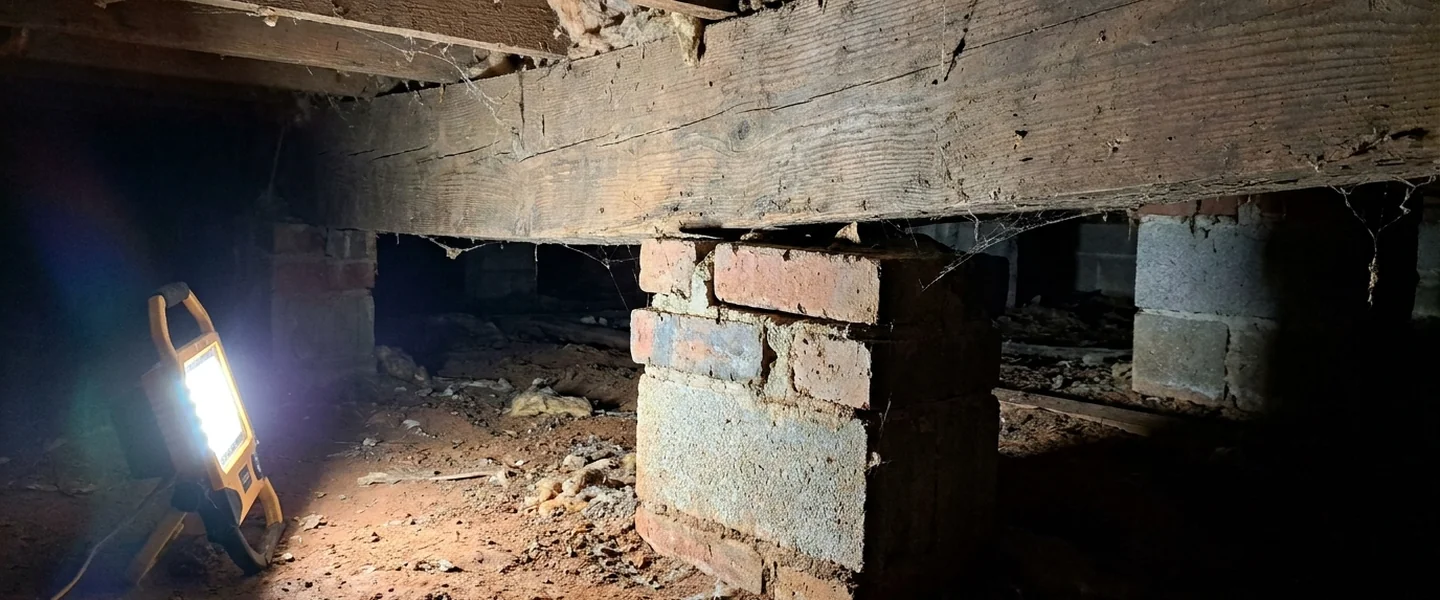
The Birmingham metro sits on the southern edge of the Appalachian Piedmont, with characteristic red clay soils that expand when wet and contract when dry. Homes built before the 1980s often used CMU (concrete masonry unit) pier supports set on small concrete pads or directly on undisturbed clay. Over decades of seasonal expansion and contraction, those piers have settled into the clay, sometimes by an inch or more. The main beam they support drops with them, and the floor above sags accordingly. This is the most common cause we see in 1950s-1970s ranch homes in Vestavia Hills and the older parts of Hoover.
Cause 2: Joist and Beam Degradation from Long-Term Moisture
An unsealed crawlspace in the Birmingham climate runs at 75-90% relative humidity all summer. Wood at those moisture contents grows mold, attracts termites (TIP Zone 1 pressure here is the highest in the country), and loses structural strength over time. Floor joists and the main beam progressively degrade, particularly at the connections to the foundation walls and at the bearing points on the piers. When enough wood has lost strength, the floor begins to sag — sometimes suddenly after a moisture event, sometimes gradually over years.
How to Tell Which Cause You Have
A floor that sags uniformly across one section of the home and where the dips line up with a single main beam usually indicates pier settlement. A floor that has multiple small dips, or sags that follow the joist layout rather than the beam layout, usually indicates joist degradation. The inspection visit determines which by measuring deflection from above, taking wood moisture readings of the joists and beam, and visually inspecting the connections. Often both causes are present at the same time in older Bessemer or Homewood housing stock.
The Permanent Fix: Adjustable Steel Supports on Concrete Footings
The right fix for pier settlement is adjustable steel Smart Jack supports installed on new, properly sized concrete footings. The footings are formed and poured in place, sized for the load and the bearing capacity of the Birmingham red clay. The supports are set on the cured footings, plumbed, and snugged to the existing beam. Over a 7-14 day period, the supports are incrementally adjusted upward to bring the floor back to level. Slow, controlled adjustment prevents the drywall above from cracking, which can happen if you try to lift a floor all at once.
Sister Beams Where Joists or Main Beam Are Compromised
Where joists or the main beam have degraded from moisture, the fix is sister-beam reinforcement. A new pressure-treated or LVL beam is installed alongside the original, mechanically fastened with through-bolts at engineered spacing. The new beam carries the load and the original beam stays in place (it still adds some strength even when degraded). Sister beams are the structural complement to the moisture work that has to happen at the same time — fix the structure without addressing the moisture and the new beam degrades the same way the original one did.
Why We Don’t Use Wooden Supports for Replacement
Some contractors still use 4×4 or 6×6 pressure-treated wood posts as replacement supports for failed CMU piers. We don’t, and here’s why: even pressure-treated wood will degrade in a high-humidity crawlspace over 15-25 years. Adjustable steel supports last indefinitely in a sealed, dehumidified crawlspace. The cost premium is small and the lifespan difference is decades. We also do not use lally columns (concrete-filled steel pipes) for residential crawlspace work — they’re a commercial product that’s overkill for the loads in a Birmingham-area home and they’re not adjustable for the slow re-leveling process.
Why “Just Jack It Up” Doesn’t Work
Homeowners sometimes ask if they can just jack up a sagging floor without doing the underlying structural work. The answer is no — temporary jacking lifts the floor while the jack is in place but does not address the cause of the sagging. Remove the jack and the floor returns to its sagged position. Worse, sudden jacking without controlled re-leveling cracks the drywall above and sometimes the masonry of the foundation walls. The right fix is permanent supports on proper footings with slow re-leveling.
Combined Approach: Structural and Moisture Together
Most Birmingham-area sagging-floor jobs we do are structural and moisture together. The structural fix (Smart Jacks, sister beams) addresses the immediate failure. The moisture fix (encapsulation with vapor barrier and dehumidifier) prevents the next failure. Doing one without the other is shortsighted — the new supports degrade in a humid crawlspace just like the old supports did. The combined install is one job, one warranty, one continuous timeline.
Timeline for Sagging Floor Repair
For pier-settlement fixes alone, plan on 1-3 days of install plus the 7-14 day adjustment period. For combined structural and moisture work, add another 2-3 days for the encapsulation portion. Total job time: typically a week to ten days from start to finish, with the floor incrementally returning to level during the second half of the timeline.
Common Misconceptions About Sagging Floors
“It’s just settling — every old house has it.”
Some settlement is normal in any home over decades. Active sagging that has gotten worse in the past few years is not normal — it indicates an ongoing structural problem that compounds over time. Catching it early is dramatically cheaper than waiting.
“If the floor is sagging, the foundation must be failing.”
Usually not. The foundation walls themselves are typically fine. The sagging is in the interior support system (piers, beam, joists), which is structurally separate from the perimeter foundation. The fix is interior support work, not foundation work.
“I can level it myself with a bottle jack.”
You can lift the beam temporarily. You cannot install a permanent support that meets code, you cannot adjust over time, and you cannot warranty the work. DIY structural support is the most common cause of partial collapses we see during second-opinion inspections.
“A new house won’t have this problem.”
Even modern subdivision construction in Helena and Trussville sees floor sagging within 10-15 years if the crawlspace isn’t sealed and dehumidified. Newer doesn’t mean immune.
Questions to Ask the Contractor
- Will you do a full structural inspection (deflection measurement, moisture readings, photographs) before quoting?
- What supports do you install — wood, lally columns, or adjustable steel Smart Jacks?
- Will the supports be set on new concrete footings sized for the local soil?
- How do you handle the re-leveling — all at once or over a 7-14 day period?
- Are you addressing the moisture cause at the same time, or just the structural symptom?
- What’s the warranty on the structural work and is it transferable?
Bottom Line
Sagging floors in Birmingham-area homes have specific causes and proven fixes. The right approach is adjustable steel supports on new concrete footings, paired with moisture remediation so the problem doesn’t return. Call (205) 576-5150 for a free 30-minute inspection that includes a deflection measurement and a written, itemized repair plan.
Service Areas We Cover
We serve Birmingham and the entire metro area. Click your suburb for local details and our typical findings in your housing stock:
Free Crawlspace Inspection in Birmingham
Same-week appointments. No high-pressure sales. Serving Birmingham and surrounding areas including Hoover, Vestavia Hills, Mountain Brook, Homewood, Trussville, Bessemer, Pelham, Helena.